4.13.2020

5 Free Online Courses To Learn Artificial Intelligence

We are living in the era of fourth industrial revolution(4IR), where Artificial intelligence has a significant role to play. This 4IR technology embedded within societies and even into the human body. From Computer enthusiasts to common people, everyone should be aware and learn this breakthrough technology.
We think about gigantic Robots from Transformers when we hear about Artificial Intelligence(AI) which is a fiction in the past but a fact today, capable of transforming the whole tech world. The field of AI consists of more than Robots such as personal assistants, self-driving cars, apprenticeship learning, behavior cloning and so on. To learn about this advanced technology, thanks to the online learning resources which offers great content to get started with artificial intelligence.

Here are the 5 free e-learning courses on Artificial Intelligence

1. UC Berkeley CS188 Intro to AI

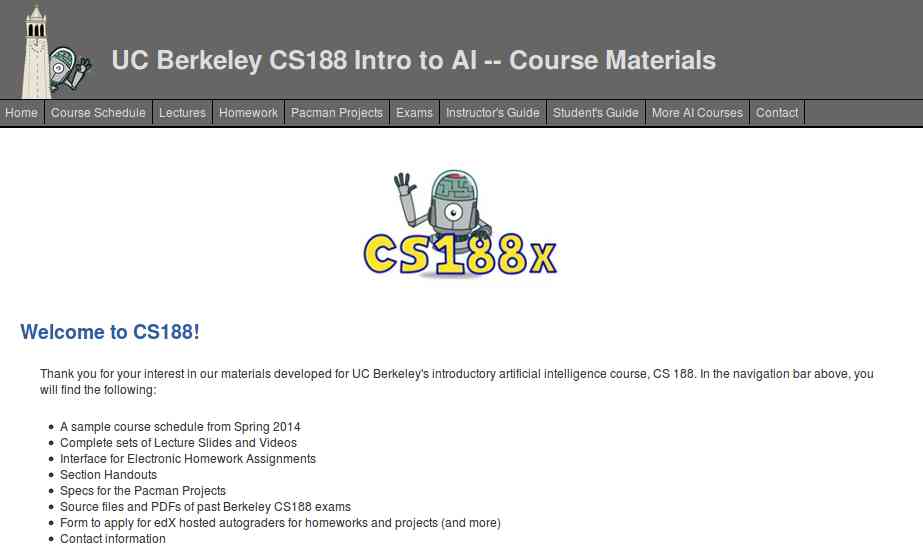
Get started with UC Berkeley AI course, this course is absolutely for beginners who are unaware of Artificial intelligence. It doesn't need any prior computer knowledge to know about AI. UC Berkeley allows anyone to learn this course for free. This course is systematically presented and consists of the following:
  • Course Schedule
  • Complete sets of Lecture Slides and Videos
  • Interface for Electronic Homework Assignments
  • Section Handouts
  • Specs for the Pacman Projects
  • Source files and PDFs of past Berkeley CS188 exams
  • Form to apply for edX hosted autograders for homework and projects (and more)
  • Contact information
Aside from this, you can also browse the following courses as well from UC Berkeley that are part of AI course:
  • Machine Learning: CS189, Stat154
  • Intro to Data Science: CS194-16
  • Probability: EE126, Stat134
  • Optimization: EE127
  • Cognitive Modeling: CogSci131
  • Machine Learning Theory: CS281A, CS281B
  • Vision: CS280
  • Robotics: CS287
  • Natural Language Processing: CS288

2. Artificial Intelligence: Principles and Techniques

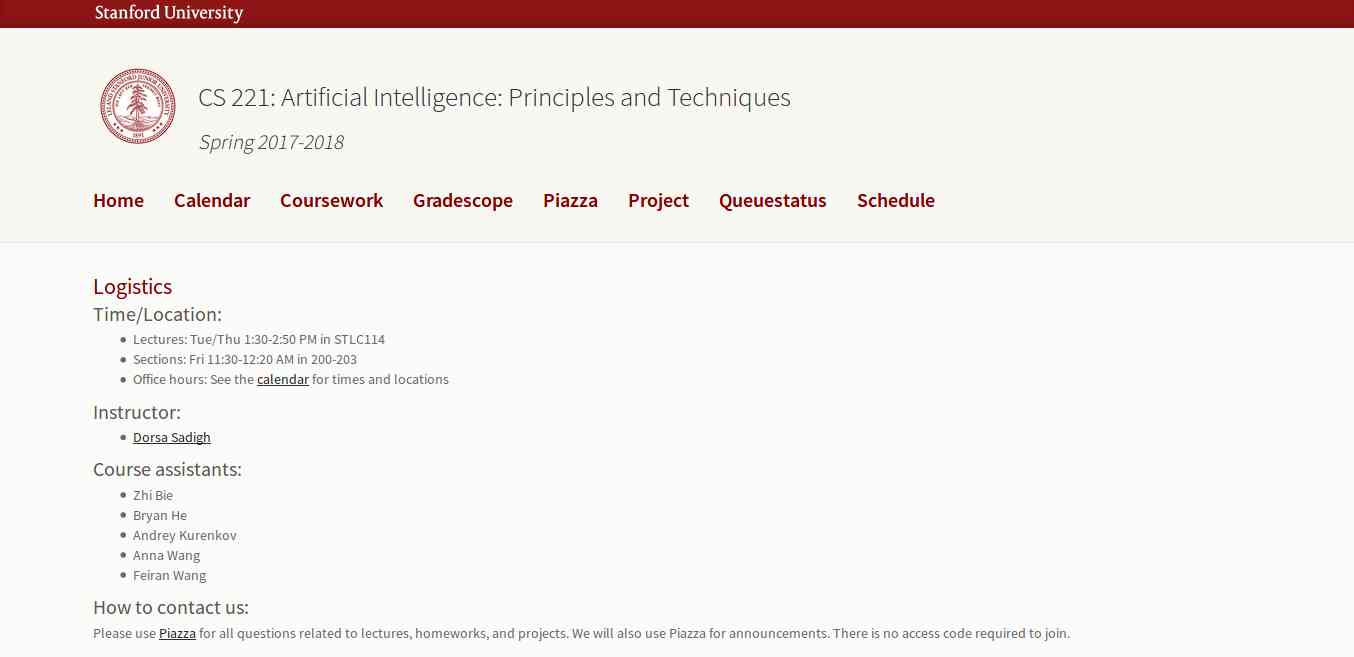
This course is offered by Stanford with great content that includes topics, videos, assignments, projects, and exams. The whole course mainly focuses on the complex real-world problems and try to find similarity between web search, speech recognition, face recognition, machine translation, autonomous driving, and automatic scheduling. Here you will learn the foundational principles of AI and implement some the AI systems. The goal of this course is to help you tackle the real-world situations with the help of AI tools. So, it is the best for the beginner to get started with AI.

3. Learn with GOOGLE AI

Who will dislike the course from Google? absolutely no one. This company is one of the early adopters of AI has a lot to offer to learners. Learn with Google AI is an education platform for people at all experience levels, it is free to access and browse content. The education resources provided by Google is from the machine learning experts of the company. These resources are the collections of lessons, tutorials, and Hands-on exercises that help you start learning, building, and problem-solving.

4. MIT 6.S094: Deep Learning for Self-Driving Cars

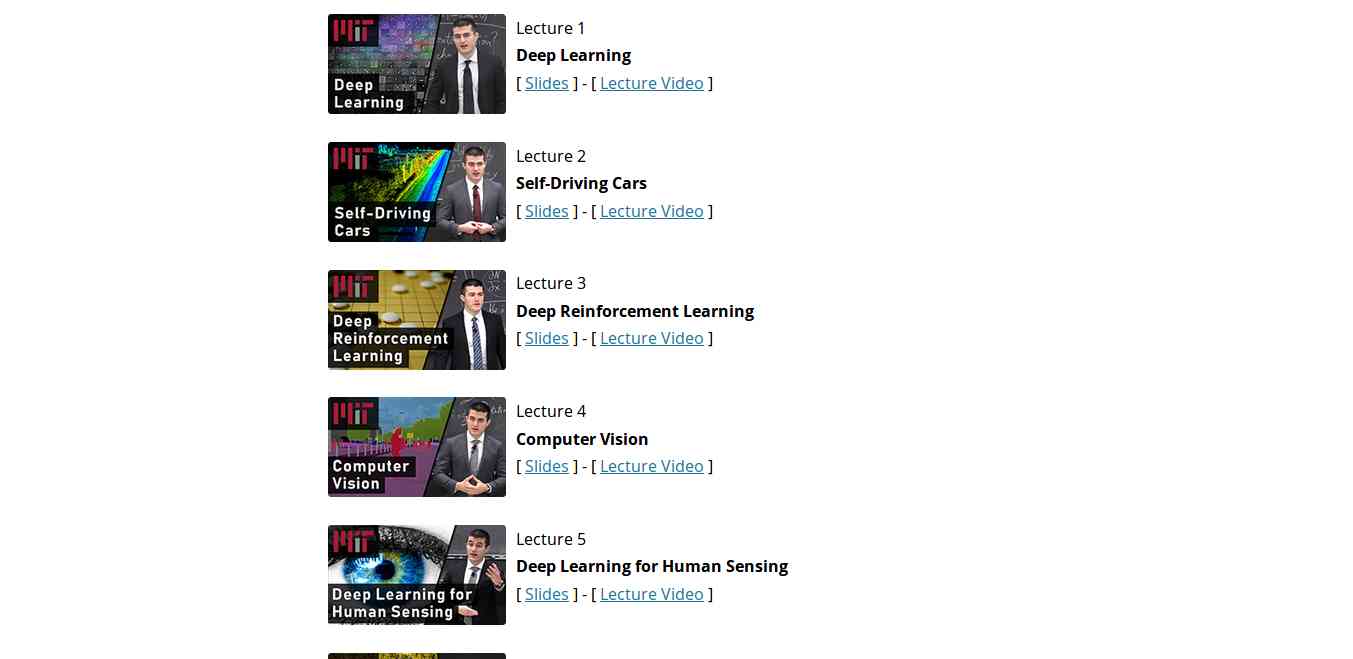
This course gives the practical overview of Deep Learning and AI. It is the course for beginners, also for the people who are getting started with Machine Learning. The course also offers a lot of benefits to the experienced and advanced researchers in the field deep learning. This MIT's course takes people into the journey of Deep Learning with the applied theme of building Self-Driving cars. However, the course also offers slides and videos to engage the learners.

5. Fundamentals of Deep Learning for Computer Vision

This course is offered by Nvidia and Nvidia Deep learning Institute. Computer Vision is one of the disciplines of AI that acquire, analyze, process, and understand images. The course is completely free and everyone who is enthusiast about AI can access and learn the course. It is a hands-on course that able to provide basics of deep learning and deployment of neural networks. With this. you will also learn the following:
  • Identify the ingredients required to start a Deep Learning project.
  • Train a deep neural network to correctly classify images it has never seen before.
  • Deploy deep neural networks into applications.
  • Identify techniques for improving the performance of deep learning applications.
  • Assess the types of problems that are candidates for deep learning.
  • Modify neural networks to change their behavior.

Read more


DSniff


"dsniff is a collection of tools for network auditing and penetration testing. dsniff, filesnarf, mailsnarf, msgsnarf, urlsnarf, and webspy passively monitor a network for interesting data (passwords, e-mail, files, etc.). arpspoof, dnsspoof, and macof facilitate the interception of network traffic normally unavailable to an attacker (e.g, due to layer-2 switching). sshmitm and webmitm implement active monkey-in-the-middle attacks against redirected SSH and HTTPS sessions by exploiting weak bindings in ad-hoc PKI." read more...

Website: http://www.monkey.org/~dugsong/dsniff/

Related links


  1. Pentest Tools Download
  2. Growth Hacker Tools
  3. Hack Tools Online
  4. Hacking Tools For Windows
  5. Hacking Tools For Windows Free Download
  6. Hacking Tools Download
  7. Usb Pentest Tools
  8. Hacking Tools And Software
  9. Top Pentest Tools
  10. Hack Apps
  11. Hacking Tools For Pc
  12. Hacker Hardware Tools
  13. Github Hacking Tools
  14. Game Hacking
  15. Hacking App
  16. Hacker Tools For Pc
  17. Hacking Tools 2020
  18. Best Pentesting Tools 2018
  19. Pentest Tools Review
  20. Pentest Tools Review
  21. Hacking Tools Usb
  22. Hacking Tools Pc
  23. Pentest Tools Port Scanner
  24. Hacking Tools For Windows Free Download
  25. Pentest Tools Nmap
  26. Hacking Tools For Kali Linux

DOWNLOAD SQLI HUNTER V1.2 – SQL INJECTION TOOL

SQLi hunter is a tool to scan for an SQLi Injection vulnerability in a website on auto-pilot. It automates the search of SQLi vulnerable links from Google using different dorks. SQLi hunter can also find admin panel page of any website by using some predefined admin page lists. Download SQLi hunter v1.2.

FEATURES

– Supports 500 results
– Url List can be Imported / Exported
– The setting for connection timeout
– Proxy Settings
If you're not totally satisfied with this tool, you can try other sql injection tools like havij , sqli dumper and sqlmap. These tools are incredibly super flexible with their advanced injection features.

DOWNLOAD SQLI HUNTER V1.2

More info
  1. Game Hacking
  2. Hacking Tools For Windows
  3. Hacker Techniques Tools And Incident Handling
  4. Pentest Tools Url Fuzzer
  5. Pentest Tools Nmap
  6. Hackers Toolbox
  7. Hacker Tools Free Download
  8. Hacker Tools Apk
  9. Pentest Tools
  10. Hacker Tools Free
  11. Hacking Tools Online
  12. Hacking Tools For Games
  13. Hacker Tools Apk
  14. Hacker
  15. Hacker Tools 2020
  16. Physical Pentest Tools
  17. Ethical Hacker Tools
  18. Hack App
  19. What Are Hacking Tools
  20. Termux Hacking Tools 2019
  21. Hack Website Online Tool
  22. Pentest Automation Tools

4.11.2020

Writing The Best Application For A Frictional Games Job

Written by Kira, who goes through and replies to all your Frictional applications.


So, you have decided to apply for a job here at Frictional Games? Great, we would love to hear from you!

…But before you hit that "send" button, you want to make sure that you are showing yourself and your talent in the best light possible. We have already written a blog post on how the recruitment process works, so you can mentally prepare for that.

In this blog we will help you construct a good application, consisting of a CV, a cover letter and the portfolio, and even get down the nitty-gritty of the email. While we hope you apply for our positions, you are obviously welcome to use the tips when applying for other jobs too.

Just remember the most important thing: Always customise your application for the position you're applying to.

A job application is like a love letter. You have to show interest in the recipient, and tell them why the two of you could be a good match specifically. You can write a letter about how great you are and send the same version to different recipients, but be warned – that's pretty transparent, and will not likely land you a (business) relationship, no matter how good you are.

In this economic situation it might be tempting to say fuck it and cast a net as wide as possible (yes, we have moved on to fishing metaphors now). But the best fish will slip through the loose holes of a haphazardly set net. Instead, try finding one good spot and throwing in a hook with a juicy bait – the juicy bait being your best application. If you are good enough, a fish will definitely bite, and a love letter recipient will definitely swoon.

Frictional is a small company with little turnover. We're not looking to burn through talent, but to find the right applicants who will stay with us for a long time. That's why we want the applicants to be interested in and motivated to work with us specifically.

Do you love us? We love you too! Now let's go write that application!


1. Read the job posting

This might sound obvious, but start by reading the job posting. Then read it again.


If you're exactly what the posting is looking for, then great. You can use your previous work as examples of why you're a good match. Are you a generalist? Pick your strong points that you would use in this job.

Feel like you don't quite fit the criteria? Do not despair. Especially women tend to not apply for jobs they don't feel 100% qualified for. Think about your best qualities. Think about the hobby projects that you've done. Those count too.

(But be realistic about it. If your skillset is wildly different from what the job would be, you might want to wait for another opening. Otherwise you are mostly wasting your own time.)

Now compare your skills to the job's requirements and get ready to use those points in the next steps.


2. CV

The CV is all about you, dearest. It's your dating profile where you can show your best angles, or that really big fish you caught once.

When the perfect job comes along, you don't want to spend hours digging out when exactly you interned at that one place. Keep a meta-CV of all your experience, skills and achievements. This can be a document, or it can be a website or LinkedIn page you can link in the CV. An accessible online CV especially good if you have gaps in your relevant experience because you were helping out at your cousin's ice cream business or similar.

Remember the previous step where we looked at the job requirements? You can now cherrypick the most relevant points from your meta-CV and put them in your tailored CV. Quality over quantity and all that. Start from the most recent relevant one.


A good CV is 1–2 pages long. If you only picked the most relevant experience, you should be able to keep it tight. But do write in detail about the relevant experience. If you only gloss over your experience in big strokes, the employer will not be able to tell what you have actually done and achieved. Share specific tasks and examples, list your best achievements.

If you have skills outside your field, such as multiple languages or software, you can list those too. Just keep them tight. But, despite being your so-called dating profile, listing hobbies might not be very relevant. But if you've done game jams or similar, go ahead! They are relevant and they count.

Do:
  • Keep a meta-CV.
  • Always customise your CV based on the position.
  • Start with the latest relevant experience.
  • Write in detail about your relevant experience.
Don't:
  • Send the same CV to every position.
  • List every job you've ever held.
  • Start your CV with the first job you ever had.
  • Start with education instead of work experience (unless you're a recent graduate).


3. Cover Letter

If the CV was your dating profile, the cover letter is your love letter. And a love letter cannot just be a glorified dating profile.

Picking relevant experience for the CV already shows that you put thought into your application. But the cover letter gives you an opportunity to show that you truly care about the company, their games and the position – or at least have knowledge about them. It's incredibly easy to spot if someone sends the same cover letter to everyone, because they only talk about themselves. You can reuse lines you've written for similar positions, but make sure to keep them relevant.

The cover letter is also a great opportunity to talk more about why the skills you have acquired would translate well into the position advertised – especially if your experience is moreso from hobby projects. Convince the company why you would be a good match for them.

It's easy to get lost in profound expressions of love, but a good cover letter is half a page to 1 page long. Being concise is also a skill.

If the job posting mentions expected salary, this is a good place to mention it.

Do:
  • Talk about why you want to work with this company specifically.
  • Talk about your skills in relation to the job's requirements.
  • Tell the company why they should hire you. Be bold.
Don't:
  • Send the same cover letter to every company. It's easy to spot.
  • Only change the name of the company in the letter. Generic wording is also easy to spot.
  • Only talk about yourself with no relevance to the company or the position.


4. Portfolio

For better or worse, looks are important. In this case your dating profile pictures are your portfolio. The portfolio is a way to back up the claim that you're as good as you say you are, for both artists, programmers and other folks.

While a good portfolio looks different depending on whether you're an artist, a designer or perhaps a communications person, there are still good general practices when it comes to putting one together. In this segment we will use artists as an example, but you can use your imagination to apply the tips to other fields.

Just like with a CV, keep a master portfolio. For artists it can be sites like Artstation or Behance, or perhaps your own site. Pick the pieces you are most proud of, but are varied enough to show off your versatility.

From the master portfolio, you should again pick the pieces most relevant to the position and create a tailored portfolio. If the company is looking for a props and environment artist, those are the things you should be concentrating on. Also look at the stuff the company has previously done. Have they only done high-poly? Their next product will probably not be low-poly.

There is no rule to how long the portfolio should be. The key is making it easy for the recruitment team to immediately see if you are a good or potential match. For an open position you can choose some pieces relevant to the position and put them in a PDF, or link them from the master portfolio. For an open job query, pick a few pieces that are most in line with what the company is doing.


It is also a good practice to mention what you actually did for your works. Here at Frictional we wear all of the hats. The artists do everything from whiteboxing to textures. We need to know if you know how to do those and didn't just make others' textures and assets look good.

Do:
  • Keep a master portfolio of all your work.
  • Send a portfolio or links to a few relevant pieces.
  • Mention what you worked on for the pieces.
Don't:
  • Send the same top picks to every company and every position.
  • Send all the portfolio pieces as separate files (links are ok).


5. Email

Chances are, there are also other jobs you have or will apply for. It's good practice to have a professional email account for official business. Something with a neutral email handle and your real name as the sender. It makes it easier to find your application later. Having a signature with your contact information and links to your master CV and portfolio is also handy.

Some email platforms will show your profile picture, so make sure you at least know what it is. You might want to think twice before using a topless beach pic or a dank meme. The recruiter will probably have a chuckle, but might not be left with the best impression.


Make sure you include some sort of cover text in the email. It can be pretty generic, informing of your interest in the position and the attachments you have provided. This is also a good place to mention your master CV and master portfolio. Even better if you get a short elevator pitch in.

Do:
  • Use your real name in the email.
  • Have a signature with contact info and links.
  • Write a short cover text, like an elevator pitch for your application.
Don't:
  • Have a shirtless profile picture. No, seriously.


6. Personal Information

Getting a feel of a person is important, but not all information you provide will help us with that. There are some things the employer is not even allowed to ask (family relations, religion…), and being upfront about them puts the potential employer in an uncomfortable position. Emphasis on the potential part. If you get hired, we will ask you for the details we need.

What a potential employer DOES need to know:
  • Real name
  • Email address
  • Country of residence
  • Links to your master portfolio and CV
  • Phone number (we don't need it but most companies do)
What a potential employer DOES NOT need to know:
  • ID number
  • Birthday
  • Home address
  • Marital status and/or children
  • Ethnicity or nationality, gender, religion. disabilities or similar


7. Think of the recruiter

The recruitment team might get hundreds of applications every day. Sometimes the recruitment team is just one human being, who also does other things.

Just like with life in general, the key word is empathy. So send the kind of application that you would like to receive.


Make sure the application easy to go through, and that the attachments are easily accessible and in proper file formats. Be sure the relevant links are easy to find, and that they work. If you want to make a recruiter happy, include your own name in the attachment names (so it doesn't become CV(69).pdf on the recruiter's computer).

Do:
  • Save your CV, cover letter and any other files in PDF format
  • Make everything easy to find
Don't:
  • Save your text files as doc/x, rtf or txt, or especially png or jpg.
  • Send your portfolio pieces as multiple separate files.


8. Afterword

There is no sure-fire way to make the perfect application. But the more tailored your application is, the better your chances are.

And lastly: even in an application, feel free to let your personality show. If the company doesn't like your genuine application, you wouldn't be happy working with them anyway. If they do… they will remember you.

Good luck!
4.08.2020

Riders Of The Pony Express - Current Status And New Ideas

Back in August I had found an old strategy article I'd been looking for, which applied directly to one of my game designs, but I didn't revisit the game itself at the time.

The other day I posted about a playtest session in which I took that old prototype off the back burner and got it to the table: Riders of the Pony Express (BGG link - looks like I ought to edit that description a little bit!).

As I mentioned in the August post, I have experienced an issue, mostly with the 5-player game. And as I mentioned in the playtest report post, I found a hand-written rules edit that I don't remember every trying before, which may solve the 5p problem for me as well, at least in the blind bid version of the game (the one which is the most gamer-y, and which I will probably stick with):

The winner of the bid must leave their winning bid card face up on the table, it is not available to them for the rest of the round.
That's it! It's so simple, and it made for some very interesting bidding dynamics all around.

With respect to the 5p problem I outlined in the August post, I had showed some math which explained why winning each bid for the minimum of $3 was fairly dominant -- you would get $24 while each opponent would get only $14. Sure, you would have to spend more traveling, and you would get a lower bonus upon returning to the post office, but even if that did kind of even things out, it isn't fun for the other players to just go through the motions of riding across the board while you visit town after town to deliver all your parcels.

In the comments on that post, I posited two solutions which could change the math, evening up the amount of money you would get compared to each opponent if you won all the bids at $3: upping the total amount from $10 to $15 in a 5p game, or allowing a minimum bid of $2 instead of $3. Neither of these really solve the problem, they just punish the player who does the annoying thing. That's a sort of "soft" solution, in that players who are trying to win probably won't do something so bad, therefore the game won't be ruined. However, the reality is that, whether they want to or not, players don't always "play to win" as much as you might think. This is especially true in the case that they haven't played before, or fully analyzed the costs of delivering.

This new solution of leaving the winning bid card face up DOES solve the problem, because it means you simply CAN'T bid $3 on every auction! If players really think that bidding the minimum is the way to go, then at least the parcels will be spread around between the players. And savvy players may start to realize they can do better if they bid higher (though if a different non-savvy player does undercut them every time, it might not be very fun, even if they do win).

I'll note also that the current rules give each player a mandatory parcel to deliver. This may be thematically awkward, but it means everyone is going SOMEWHERE each round, making certain other parcels "on the way."

Things to try in the next test
As I mentioned in the last post, I had a hard time finding something I thought really needed changing. Here are a few changes I'll try for the next playtest:
* Increase value of Bears from +2 to +3. This should make them more distinct from Bandits, and will make the Shotgun item more valuable (currently it is probably not really valuable enough)
* Deal round 1 mandatory parcels face up instead of face down, to see if that makes the auction phase any more interesting (it might actually be worse, but it's worth a try!)
* Instead of dealing mandatory parcels for rounds 2 and 3, layout N+1 face up and let players take one when they arrive at the post office (so drafting them in the order they finish the round).
* Treat the mandatory parcel just like the ones obtained by auction - keep it face up and you're required to deliver it that round

Currently the mandatory parcels are face down, they take up space in your inventory, and they aren't required to be delivered until the end of the game, while face-up parcels obtained in the auction phase are required to be delivered that round, but they don't take up your inventory space. Here's a quote from a previous post when I implemented it:

One issue that's come up in the past is the face down parcel cards. Some players feel they "force" a certain path, and I can see that... so I tried a change. Face down parcels aren't from your boss, they're like side jobs. You're not REQUIRED to deliver them each round, but they take up space in your inventory. I made player boards to help show this - you have room for 1 face down card and 4 items (expanded from 3), and if you don't deliver your 1st face down card, then the next one takes up 2 of your item slots (this is obvious graphically). Currently I'm saying that you have to deliver them by the end of the game, but another option is to simply apply a penalty if you don't (so if it's more expensive to deliver than to take the penalty, maybe you just take the penalty).

But you do get the mandatory parcel before having to claim other parcels, and now maybe you'll have chosen it (per tweak listed above), so maybe it'll be fine to treat them the same as the parcels you get in the auctions. I could do with more elegant rules here, so maybe all parcels should just be face up, required to deliver that round.

* Treat each hazard and each town as a space, and let players move from space to space, rather than from town to town. One of my players thought this would be way more intuitive, and it does have the advantage that if 2 players arrive at the same town at about the same time, the one that fiddles around less (spends less time acting int he town) will leave first, irrespective of turn order.

Originally, I had players moving from town to town. Here's another quote from a previous post about why I changed that:
to better represent what's going on (and to make fair races between players), I specified that you don't move from town to town - you move from town to hazard tile, then on your next turn you arrive in the town, discard any parcels, pick up an item if you like, and then move to the next hazard.
So now you basically move from hazard to hazard, and do some stuff in a town as yo pass through. Though it has't bothered me at all, it IS a little weird. So I'll try alternating (move from hazard to town, town to hazard, etc). I thought it might be odd to have twice as many turns, where half of them are 0-1 time cost. When paying 0 time, do you just go again right away? If that's the case more often than not, then why make it a separate turn? But maybe I should make town turns a little more costly -- like you spend 1 time for each thing you do, minimum 1. So like, you had to rest or change out your horse at the very least (1 time), and if you go around making deliveries or shopping for items, it'll cost you more time.

So for a hazard space you spend the listed amount, plus hazard modifier, minus item modifiers (minimum 1). And for a town space you spend 1, plus 1 for each delivery you make, and for at most 1 item you pick up. Which means you could spend 1, 2, 3, even 4 time in a town (in fact, I think it could theoretically max out at 5 if you have both parcels and a package item to deliver, and if you pick up an item).

This change will make longer, more circuitous routes quite a bit more expensive, which might have the side effect of encouraging players to bid higher on parcels, or more often say "no thanks" and let the auctioneer take the parcel. I'd like that to be something that can happen if you choose wisely and want it to, or choose poorly and get stuck with it, but hopefully not too often because things are just too expensive! I'll have to see if that goes too far.